
Table of Contents
Introduction
If you are searching for a powerful AI agent in 2026 that does more than just chat — one that actually completes real-world tasks autonomously — then two names dominate the conversation: OpenClaw and AutoGPT.
Both are open-source. Both are autonomous. Both promise to revolutionize the way you work with AI. But they are built on very different philosophies, and choosing the wrong one could waste weeks of your time.
In this complete OpenClaw vs AutoGPT 2026 guide, we will break down everything — architecture, features, privacy, real-world use cases, pricing, and who should use which — so you can make the right decision today.
What Is OpenClaw?
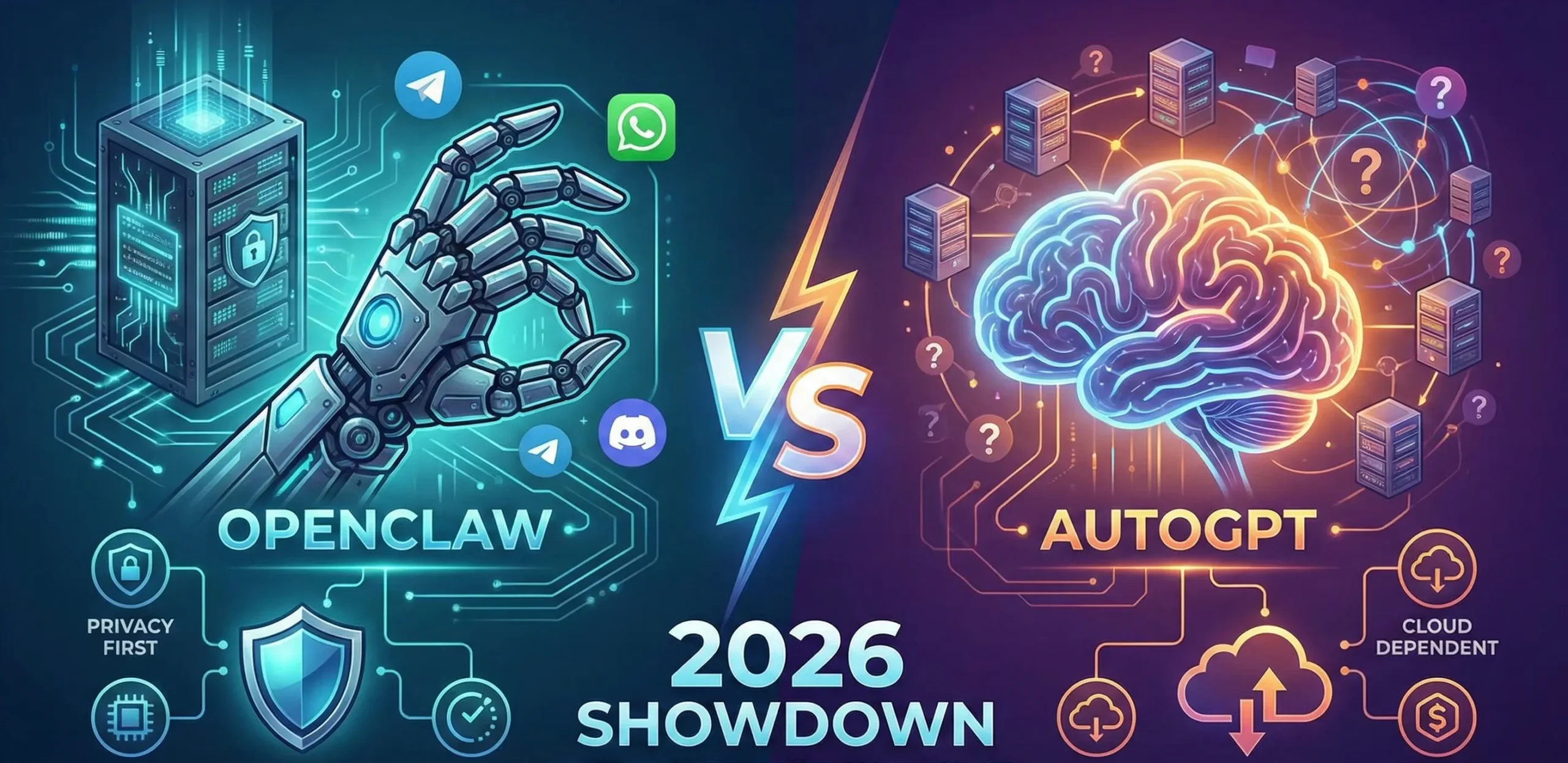
OpenClaw is an open-source autonomous AI agent that runs entirely on your own machine, server, or VPS. Unlike traditional AI chatbots, OpenClaw is not just reactive — it is proactive. It listens, plans, executes, and reports back — all without you needing to be present.
What makes OpenClaw truly unique is its messaging-first architecture. You can control it directly through WhatsApp, Telegram, Discord, Slack, and 50+ other messaging platforms. Simply send a message and your AI agent gets to work — no separate interface required.
OpenClaw was designed with privacy at its core. All execution happens locally, meaning your sensitive data never leaves your machine. This makes it an ideal choice for businesses, developers, and privacy-conscious users.
OpenClaw Key Features:
- ✅ 100% local execution — zero cloud dependency
- ✅ 50+ messaging platform integrations (WhatsApp, Telegram, Discord, Slack, Signal)
- ✅ Persistent memory using SQLite + Qdrant/Postgres pgvector
- ✅ Browser automation, file management, email handling, calendar scheduling
- ✅ Multi-LLM support — works with GPT-4, Claude, Gemini, and local models
- ✅ Self-extending capability — builds new tools when existing ones fall short
- ✅ Built-in 24/7 heartbeat monitoring and crash recovery
- ✅ Cost guardrails to prevent unexpected token/API overspending
What Is AutoGPT?
AutoGPT is the AI agent that started the autonomous AI revolution back in 2023. Built on top of GPT-4, it allows users to set a high-level goal and then lets the agent autonomously plan and execute tasks to achieve it — including internet research, file writing, code execution, and more.
AutoGPT became massively popular because it was the first tool to show the world what an AI agent could do beyond simple Q&A. It chains multiple GPT-4 calls together to simulate reasoning, planning, and task execution in a loop.
AutoGPT Key Features:
- ✅ Internet access for real-time research and browsing
- ✅ Long-term and short-term memory management
- ✅ GPT-4 powered reasoning and text generation
- ✅ File storage, reading, and summarization
- ✅ Plugin and extension support
- ✅ Easy to get started for beginners
OpenClaw vs AutoGPT 2026: Full Comparison
Feature-by-Feature Breakdown
| Feature | OpenClaw | AutoGPT |
|---|---|---|
| Deployment | Local / VPS / Server | Local / Cloud |
| Data Privacy | 100% Local — zero data leak | Cloud-dependent |
| Messaging Control | WhatsApp, Telegram, 50+ apps | Not supported |
| LLM Flexibility | GPT-4, Claude, Local Models | Best with OpenAI only |
| Memory System | SQLite + Vector DB (pgvector) | Basic text logs |
| Crash Recovery | Built-in automatic recovery | Manual restart required |
| Token Efficiency | 5,000–15,000 tokens per task | Very high consumption |
| Self-Extending | ✅ Builds new tools automatically | ❌ No |
| No-Code Interface | ✅ Yes | ❌ Limited |
| Codebase Maturity | 31,000+ lines of code | ~11,000 lines |
| Cost Control | Built-in guardrails | Manual monitoring needed |
1. Performance & Reliability
When it comes to real-world reliability, OpenClaw has a clear edge. It is battle-tested for 24/7 unattended operation and includes a built-in heartbeat monitoring system that automatically detects and recovers from crashes. If a task fails, it handles the error gracefully and notifies you via your preferred messaging platform.
AutoGPT has a well-known reliability issue — its autonomous reasoning loops can sometimes get stuck in infinite cycles, consuming tokens and API credits without completing the task. This is frustrating, especially for complex multi-step workflows where human supervision is not always available.
Winner: OpenClaw ✅
2. Privacy & Data Security
In 2026, data privacy is not optional — it is essential. OpenClaw runs entirely locally, which means your files, credentials, emails, and business data never leave your machine. This is particularly important for businesses handling sensitive client information.
AutoGPT relies heavily on OpenAI’s cloud APIs. Every task you run sends data to OpenAI’s servers for processing. For personal projects this may be acceptable, but for professional or business use cases involving confidential data, this is a significant risk.
Winner: OpenClaw ✅
3. Ease of Use
AutoGPT wins here for beginners. Setting it up requires minimal technical knowledge — install, enter your OpenAI API key, set a goal, and you are running. It has a clean web UI and plenty of tutorials available.
OpenClaw has a slightly steeper initial setup since it runs on your own server or VPS. However, once set up, daily use is incredibly simple — you just message it on WhatsApp or Telegram like you would a human assistant. Its visual no-code interface also makes it accessible for non-technical users.
Winner: AutoGPT (for first-time setup) | OpenClaw (for daily long-term use) ✅
4. Integration & Ecosystem
This is where OpenClaw completely dominates. With support for 50+ messaging platforms including WhatsApp, Telegram, Signal, Discord, Slack, and more, OpenClaw fits naturally into your existing communication workflow.
You can send a WhatsApp message like “Schedule my meeting for tomorrow 3 PM and email the agenda to the team” — and OpenClaw will do it, confirm back, and remember your preferences for next time.
AutoGPT lacks native messaging integration. You need to interact with it through its web interface or terminal, which is significantly less convenient for daily use.
Winner: OpenClaw ✅
5. Cost & Token Efficiency
AI agent costs can spiral quickly if not managed properly. OpenClaw uses only 5,000–15,000 tokens per task and includes built-in cost guardrails that prevent accidental overspending. You also have the option to use free local LLMs like LLaMA or Mistral, bringing your API cost to zero.
AutoGPT is known for high token consumption. Complex tasks can easily burn through thousands of tokens across multiple reasoning loops before even completing the first step. Without careful monitoring, API costs can become substantial.
Winner: OpenClaw ✅
6. Security Vulnerabilities
It is worth noting that OpenClaw had a publicly disclosed security vulnerability — CVE-2026-25253 — which exposed certain internet-facing instances to unauthorized access. This has since been patched, but users running OpenClaw on public-facing servers must ensure they are using the latest version and follow proper security hardening practices.
AutoGPT has its own security concerns related to prompt injection and unintended file system access during autonomous task execution.
Both tools require responsible setup and configuration for secure use.
Who Should Use OpenClaw?
OpenClaw is the right choice if you:
- Need a privacy-first AI agent where data stays local
- Want to control your AI via WhatsApp or Telegram
- Are running business workflows that need 24/7 reliability
- Are a developer or system administrator who wants full customization
- Need to connect your AI agent to multiple platforms and APIs simultaneously
- Want to reduce API costs by using local LLMs
Who Should Use AutoGPT?
AutoGPT is the right choice if you:
- Are a complete beginner wanting to explore AI agents quickly
- Need simple one-time task automation without complex setup
- Are comfortable with cloud-based OpenAI processing
- Want access to a large community with extensive tutorials and plugins
- Are prototyping or experimenting with autonomous AI concepts
OpenClaw vs AutoGPT 2026: Final Verdict
| Category | Winner |
|---|---|
| Privacy & Security | 🏆 OpenClaw |
| Performance & Reliability | 🏆 OpenClaw |
| Messaging Integration | 🏆 OpenClaw |
| Token Cost Efficiency | 🏆 OpenClaw |
| Beginner Ease of Setup | 🏆 AutoGPT |
| Community & Plugins | 🏆 AutoGPT |
| Long-Term Daily Use | 🏆 OpenClaw |
OpenClaw wins 5 out of 7 categories in this OpenClaw vs AutoGPT 2026 comparison. For serious users — developers, business owners, freelancers, and power users — OpenClaw is the more capable, private, and cost-effective solution in 2026.
AutoGPT remains a great starting point for beginners who want to understand AI agents without diving into server setup. But for anyone who wants real autonomous AI power that works reliably day after day — OpenClaw is the clear winner.
Conclusion
The AI agent landscape in 2026 has matured significantly, and both OpenClaw and AutoGPT have their place. However, when judged on the criteria that actually matter — reliability, privacy, integration, cost, and real-world usefulness — OpenClaw vs AutoGPT 2026 is not even close.
OpenClaw represents the next generation of AI agents: local, private, always-on, and deeply integrated into the tools you already use every day. If you are ready to upgrade your workflow with a truly autonomous AI agent, OpenClaw is where you should start.
Our Services click and see